Troll Platform Devlog #1: From First Prototype to Today
What happens when the floor that looks safe collapses? Here is how Troll Platform grew from small twists into a 100-level game.
What happens when a floor that looks safe collapses? What if the exit door runs away just as you reach it? In a platformer, the biggest obstacle is sometimes not the jump itself, but trusting a rule you just learned a little too much.
Troll Platform started from these small twists. Developed with Godot, the game has grown into a 100-level structure with distinct worlds and a character of its own. In this first devlog, we share how the original idea became today’s game and what we had to rethink along the way.
1. The first idea: simple moves, a suspicious world
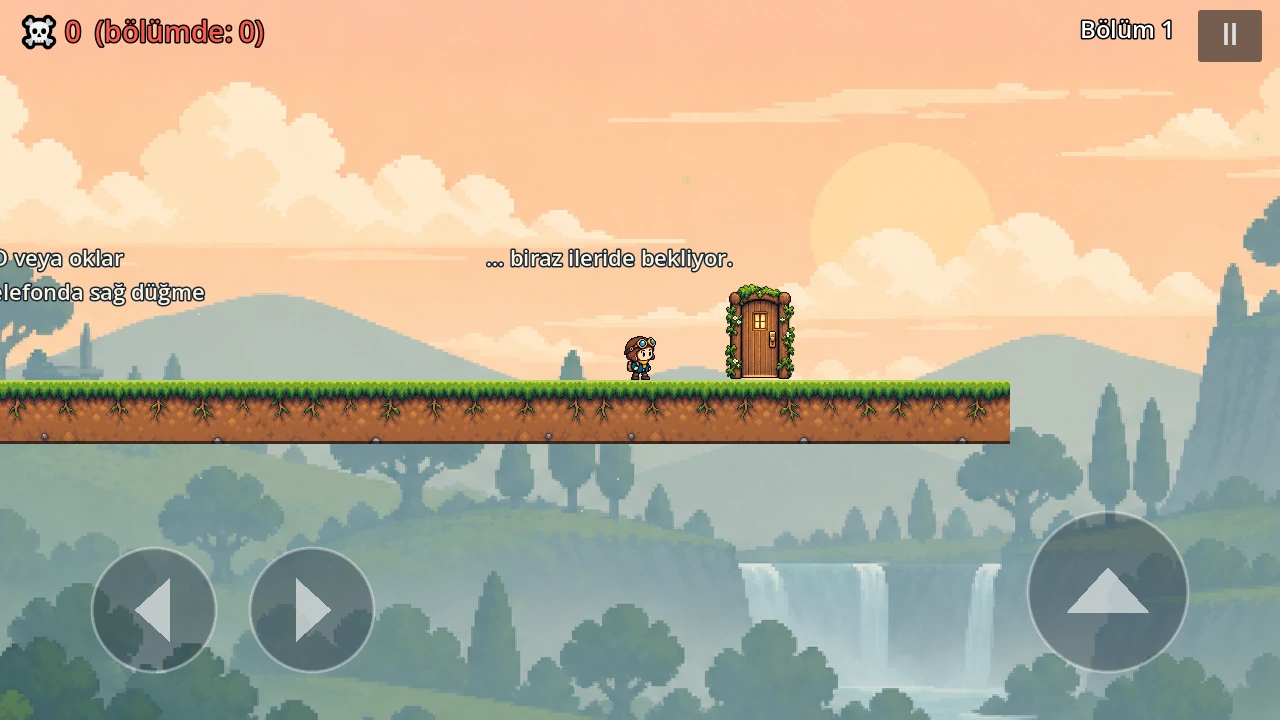
At its core, the game is about moving left and right, jumping and reaching the exit. Clear controls leave room for the surprises in each level. We don’t want players learning a new button combo in every room; we want them to solve unexpected situations with moves they already know.
So the first structure took shape around platforms, gaps and traps. Collapsing floors, invisible blocks, moving saws, missiles and deceptive exits became the game’s main tools.
The design question became clearer over time: what did the player learn after a mistake? If they can make a different decision on the next try, the trap adds something to the game. If they just die at the same spot again and again, that level needs rework.
2. First, solid movement and retries
In a trap-filled platformer, the feel of control is especially important. Players should understand when the character will jump, how it stops and how much it can change direction in the air.
The movement system has short and long jumps, air control and tolerances that make jumping more forgiving. For example, there is a little leeway for a jump pressed just after leaving a platform edge. A jump pressed just before landing is also remembered for a moment.
We were careful to preserve this feel in later art updates. When the character’s drawing changed, its speed and collision box didn’t change with it, so the new look sat on top of controls players were already used to.
3. September 18: cleaning up bugs that carried into the next attempt
In the first big revision round, we saw that some problems weren’t limited to a single attempt. A collapsing floor’s fall animation could continue after death, and a missile launcher’s pending shot could spill into the next attempt. A fake exit’s delayed death also needed to be cancelled. And returning to the menu from the checkpoint panel could leave the game paused.
We fixed these four behaviors and added tests to make sure they don’t come back. When players respawn, they shouldn’t fall victim to an invisible process left over from the previous try.
In the same period, we reordered the opening levels. The first two highlight movement and a small joke. Then come collapsing floors that give a warning, invisible blocks that reveal themselves on first contact, slow saws and missiles. We also moved easy examples of spikes and lasers to earlier levels.
4. New traps, different decisions
To expand the game, we added four mechanics: the fleeing platform, the falling ceiling, the saw that stops when you look at it, and the button-operated door.
Each of these traps asks for a different behavior. The fleeing platform requires waiting for its movement. The falling ceiling introduces the idea of triggering a danger first and then getting past it. The look-to-stop saw makes the direction the character faces matter. The button door sometimes means visiting somewhere else instead of heading straight for the exit.
We placed the first examples in levels 15, 18, 22 and 25. This is also where an important gap we’d notice later began: introducing a mechanic didn’t mean using its full potential.
5. Mobile play and personal progress
Beyond gameplay, the small flows around the game were reworked too. The visible pause button, retry, in-game settings and return-to-menu flow were refined. A safe pause was added for when the app loses focus.
The size, opacity and edge distance of the touch buttons became adjustable. Right- and left-handed layouts were kept. Options to reduce screen shake and flashing were part of this work too.
We added replaying unlocked levels, plus best time and fewest deaths per level. A short results screen lets players see their own performance, so there is a reason to try a cleaner or faster run after beating a level.
6. September 19: worlds get their own look
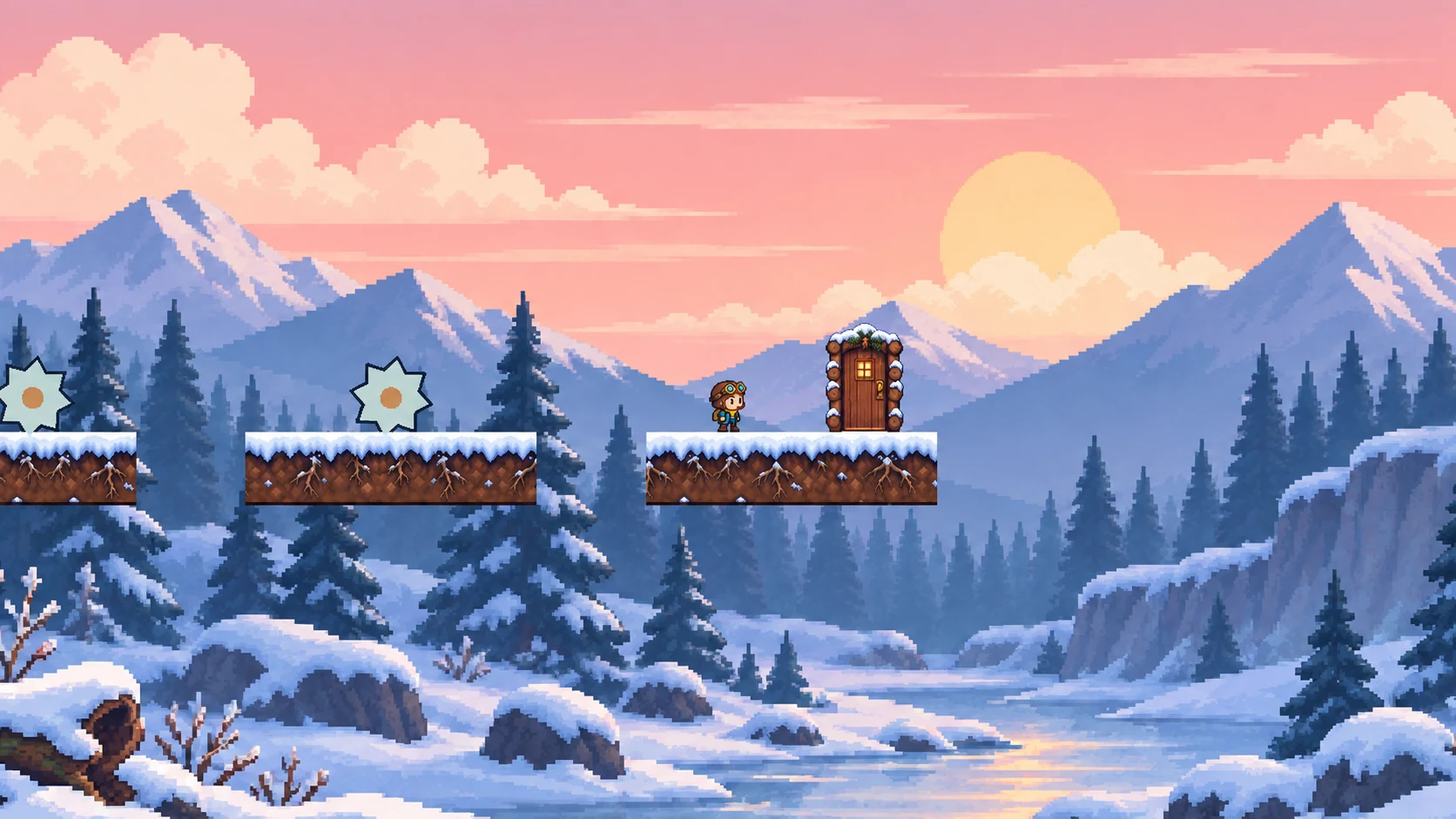
The biggest visual step was 30 main themes and a separate finale look. We built environments ranging from meadows to ice caves, factories to neon cities, candy worlds to lava caves.
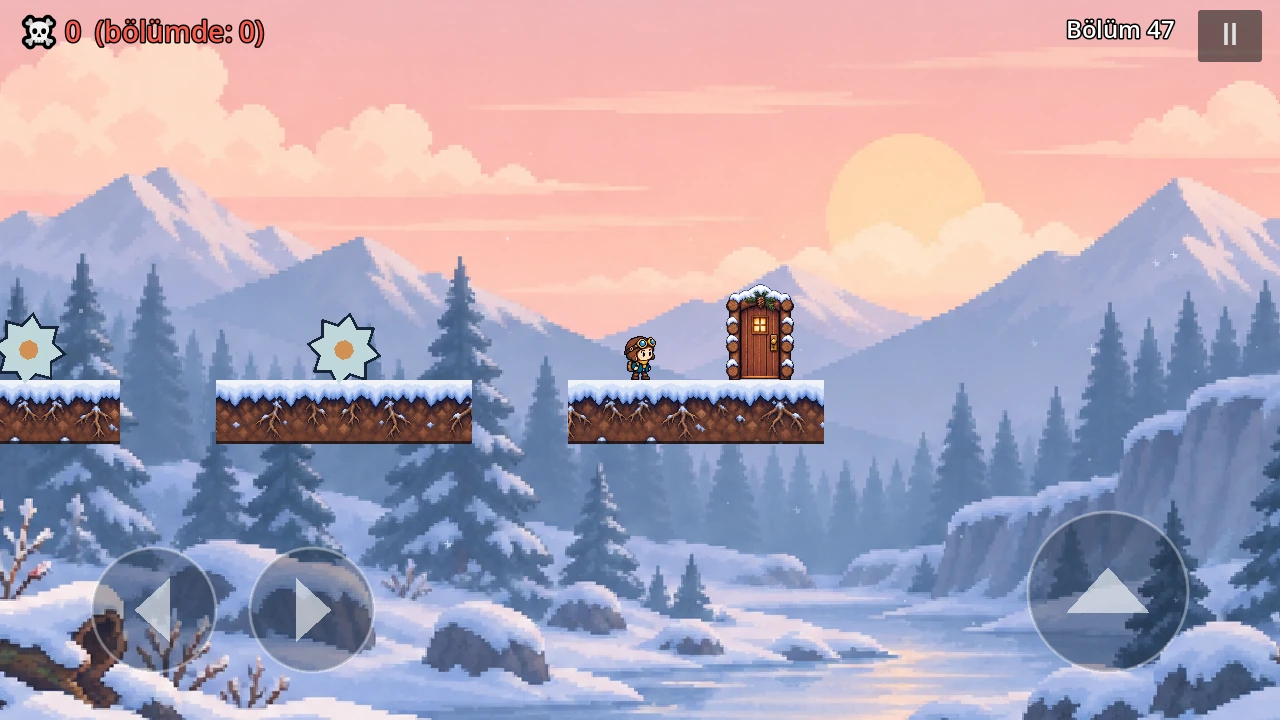
In each theme, the platform material and exit door change along with the background. A floor in an icy world looks different from one in a wooden world, and doors match their surroundings.
The theme distribution isn’t random. The first 10 levels share a starting world. After that come theme groups of three levels each. The last three levels return to the opening meadow with a different atmosphere.
While updating the art, we made sure not to give away the game’s jokes. Fake floors don’t use a different texture from solid ones. Normal, fake and fleeing doors all share the same world’s visual language.
7. Adding motion and atmosphere to the worlds
After the new art, we tackled ambient effects. Snowy areas have snow, autumn has leaves, factories have sparks, the mushroom forest has spores, and different environments use rain, dust or light motes.
The character’s jump and landing particles change with the surface too. Snow, sand and metal don’t give the same effect. Small motions around the doors complete the visual consistency.
It was important that effects never hide hazards. So we kept the atmosphere behind gameplay objects and limited the particle count. Low graphics and reduced flashing settings are also tied into this system.
8. The face of the game: the Goggled Explorer
As the worlds evolved, the old character fit the new look less and less. So we prepared three character drafts and chose the Goggled Explorer as the main character.
With a pilot cap, blue goggles, a yellow scarf, a turquoise jacket and a small bag, the Explorer is now at the center of the game. Idle, blink, run, rise and fall poses are hooked up in the game. The character following the door in the menu and the trail left after death switched to the same design.
We kept the other two drafts. We’re waiting until the main game is finished before considering them.
9. October 4: making traps belong to their worlds
Once the character and environments were refreshed, the flat shapes of the old traps stood out more. This time we visually redesigned the saws, missiles, spikes, laser heads, the falling ceiling and the button door.
36 new drawings were made across six material families: forest and wood, ice and crystal, industrial metal, runic stone, toy and candy, dark stone and lava. These families were matched with color accents that suit the existing themes.
We added an eye and a stop sign to the look-to-stop saw. The button’s state became clearer. The laser’s hard-edged glow was softened. Throughout this work, we kept the traps’ existing speeds and collision areas.
10. The latest round: why did a good-looking game start to feel repetitive?
After the visual updates, we looked at the level flow again and found an important problem: players were learning the traps, but later levels didn’t always ask for different decisions.
There were long stretches dominated by invisible blocks or collapsing floors. Meanwhile, the fleeing platform, falling ceiling, look saw and button door we had introduced didn’t come back often enough.
So we reworked the layout of 36 levels, mostly in the middle and late game. In the new layouts, invisible steps become part of the path, some buttons have to be reached from an upper floor, and some exits require backtracking after finding a key further ahead.
Traps also ask different questions in combination. You can stop the saw with your gaze, but the floor beneath you keeps collapsing. You can reach the fleeing platform, but another obstacle waits on landing. Waiting for the laser’s safe moment is the right call; doing it on a collapsing bridge is not.
We placed free checkpoints in the long combinations. We kept the early tutorial levels and level 100’s final door joke. And we aimed for the stretch before the last level to use everything learned more thoroughly.
11. How do we check the changes?
We don’t just check that new layouts open as files. Automated gameplay tests feed movement and jump inputs into the real character controller. The character tries to reach the exit without teleporting and without traps being disabled.
Valid routes were verified for all 36 reworked levels. In new layouts with checkpoints, scenarios of deliberately dying and continuing also passed. We also checked that all 100 levels load, themes apply and the related trap behaviors work.
To study the feeling of repetition, we ran simpler experiments too. A controller that only runs right completed just one of the new layouts; one that keeps jumping forward completed two. We don’t treat these results as an exact measure of the difficulty players will face, but they help us understand how far a single behavior can get you.
12. Where are we now, and what’s next?
Today, Troll Platform continues development with its 100-level structure, 30 main themes, a special finale look, the Goggled Explorer and theme-matched traps. Recent work focuses on level variety, decision-making and difficulty balance.
Our next priority is finishing balance and visual checks on the new layouts, and evaluating performance and touch controls on real Android devices. Passing automated tests on desktop doesn’t mean the phone experience is done.
Extra characters and paid themes are ideas we’re saving for a later stage. We don’t offer a cosmetic store or payment system yet; we want to finish the main game first.
Throughout development, we keep coming back to the same question: when players try again, are they thinking about doing something different? That is the measure we want to follow as Troll Platform grows.
We’ll share the game’s next steps in future FRK Yazılım devlogs. If you’re curious about what we’ve learned as a one-person studio, see this article too.